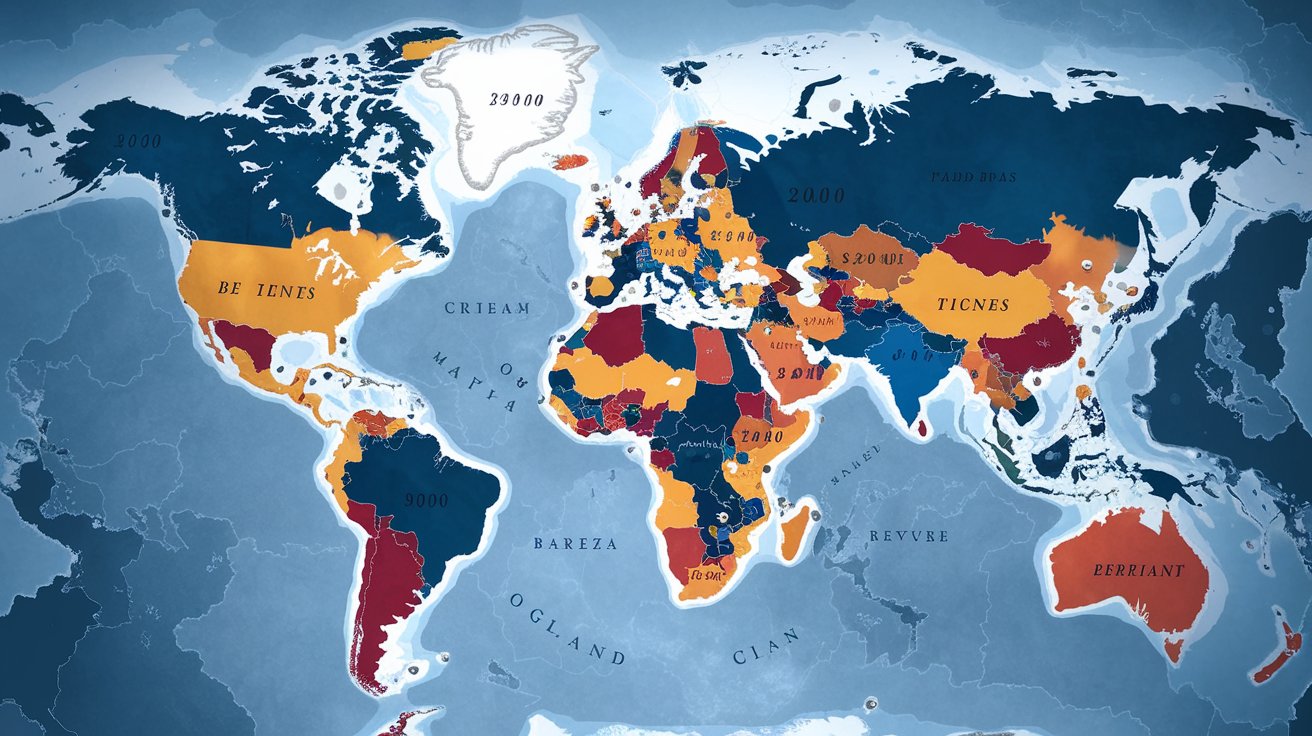
The spread of Buddhism map reveals one of history’s most significant religious migrations, originating in northeastern India around the 5th century BCE and expanding across Asia over two millennia. Understanding where Buddhism spread requires examining key trade routes, particularly the Silk Road, and identifying the distinct paths of Theravada and Mahayana traditions. This comprehensive guide maps the journey of Buddhism through India, Central Asia, China, Southeast Asia, and beyond, providing historical context, migration patterns, and the cultural diffusion that shaped millions of lives across continents.
Where Was the Spread of Buddhism: Origins and Initial Expansion
The spread of Buddhism began in the Gangetic plains of northeastern India, specifically in modern-day Bihar and Uttar Pradesh, where Siddhartha Gautama achieved enlightenment around 528 BCE. The religion initially expanded within the Indian subcontinent during the Mauryan Empire, particularly under Emperor Ashoka’s reign from 268 to 232 BCE. Ashoka’s conversion to Buddhism after the brutal Kalinga War marked a turning point, as he sent missionaries to spread Buddhism throughout his vast empire and beyond. Archaeological evidence from 2026 research confirms Buddhist establishments in Sri Lanka, Myanmar, and parts of Afghanistan dating to this period, demonstrating the religion’s early geographical reach.
The initial diffusion of Buddhism followed established trade routes and royal patronage networks. Within India, Buddhism spread from the Magadha region to major urban centers like Taxila, Ujjain, and Sanchi. By the 3rd century BCE, Buddhist teachings had reached the northwestern frontiers of the Indian subcontinent, establishing monasteries in Gandhara (modern-day Pakistan and Afghanistan). This northwestward expansion created the foundation for Buddhism’s eventual journey along the Silk Road. Current demographic studies indicate that while Buddhism declined in its Indian birthplace by the 12th century CE, these early spreading patterns established permanent Buddhist populations in Sri Lanka and Southeast Asia that persist into 2026.
The Route of Spread of Buddhism Along the Silk Road
The Silk Road served as the primary corridor for Buddhism’s expansion into Central and East Asia from the 1st century BCE through the 10th century CE. This network of trade routes connected the Mediterranean world with China, passing through Central Asian oases like Dunhuang, Kashgar, and Samarkand. Buddhist monks and merchants traveled these routes together, establishing monasteries at strategic points that served as rest stations, translation centers, and teaching institutions. The Kushan Empire, which controlled large portions of the Silk Road from the 1st to 3rd centuries CE, played a crucial role in facilitating this religious transmission, with rulers like Kanishka actively patronizing Buddhist institutions.
Archaeological discoveries through 2026 have revealed extensive Buddhist cave complexes along the Silk Road, including the Mogao Caves near Dunhuang containing over 492 temples with Buddhist art spanning a millennium. The transmission occurred in stages: Buddhism reached the Tarim Basin by the 1st century CE, entered China proper during the Han Dynasty around the 1st century CE, and arrived in Korea by the 4th century CE. Japanese historical records indicate Buddhism’s official introduction to Japan in 538 CE via Korean envoys. The Silk Road facilitated not just geographical spread but also doctrinal evolution, as Mahayana Buddhism developed and flourished along these routes, incorporating Central Asian and Chinese philosophical elements that distinguished it from the Theravada tradition spreading southward.
How Did Buddhism Spread Throughout Asia: Regional Pathways
Buddhism’s expansion throughout Asia followed distinct regional pathways based on geography, existing cultural frameworks, and political structures. The spread to Southeast Asia occurred primarily through maritime routes beginning in the 3rd century BCE, with Indian merchants and monks establishing Buddhist communities in Burma (Myanmar), Thailand, Cambodia, and the Indonesian archipelago. Theravada Buddhism became dominant in mainland Southeast Asia, while early Mahayana and later Vajrayana influences shaped Indonesian Buddhism until Islam’s arrival. Recent 2026 surveys show Thailand maintains a 95% Buddhist population, directly traceable to these ancient missionary efforts from India and Sri Lanka.
The northern transmission route brought Buddhism to Tibet, Mongolia, and eventually Russia’s Buddhist regions through a different pathway. Buddhism entered Tibet in two waves: the early diffusion in the 7th century CE under King Songtsen Gampo, and the later diffusion from the 11th century onward that established the distinctive Tibetan Buddhist tradition combining Mahayana and Vajrayana elements. From Tibet, Buddhism spread to Mongolia in the 16th century and to the Buryat and Kalmyk peoples of Russia by the 17th century. The eastward spread through China influenced Vietnam, where Buddhism arrived via both Chinese cultural influence and direct Indian maritime contact, creating a unique synthesis that persists in Vietnamese religious practice as documented in 2026 religious demographics.
Who Spread Buddhism to Asia: Key Figures and Movements
Emperor Ashoka remains the most influential figure in Buddhism’s early expansion beyond India, sending diplomatic missions and monastics to Sri Lanka, Central Asia, and Southeast Asia around 250 BCE. His son Mahinda and daughter Sanghamitta led the mission to Sri Lanka that established Buddhism as the island’s predominant religion. Historical texts identify Buddhist missionaries sent to Syria, Egypt, Macedonia, and Burma, though evidence for Mediterranean transmission remains debated. Ashoka’s rock edicts, discovered across South Asia, document his commitment to dhamma (Buddhist principles) and provide the earliest mapped evidence of Buddhism’s geographical reach.
Individual monks played crucial roles in transmitting Buddhism to specific regions. Kumarajiva, a 4th-century translator, brought Buddhist texts from Central Asia to China and produced Chinese translations that shaped East Asian Buddhism. Bodhidharma, traditionally credited with bringing Chan (Zen) Buddhism to China around 520 CE, established practices that would later define Japanese and Korean Zen. Padmasambhava introduced Vajrayana Buddhism to Tibet in the 8th century, synthesizing Indian tantric practices with indigenous Bon traditions. In Southeast Asia, the monk Shin Arahan converted the Burmese King Anawrahta to Theravada Buddhism in 1056 CE, initiating Burma’s transformation into a major Buddhist center. Contemporary scholarship in 2026 recognizes that while individual figures are celebrated, the spread of Buddhism resulted from complex interactions between merchants, diplomats, translators, artists, and local rulers across centuries.
Spread of Buddhism Timeline: Major Milestones by Century
The chronological spread of Buddhism can be mapped through distinct phases spanning over two millennia. The foundational period from 528 BCE to 100 CE saw Buddhism establish itself in India and begin expansion to Sri Lanka, Central Asia, and possibly Southeast Asia. The 3rd century BCE marked a critical turning point with Ashoka’s missions, while the 1st century CE witnessed Buddhism’s entry into China via the Silk Road. This early period established the geographic template for all subsequent expansion, with southern and northern transmission routes clearly differentiated by doctrinal emphasis and cultural adaptation.
The classical expansion period from 100 CE to 1000 CE represents Buddhism’s peak geographical spread. Major milestones include: Buddhism becoming China’s major religion by the 6th century CE, official adoption in Korea around 372 CE, arrival in Japan in 538 CE, and establishment in Tibet during the 7th-8th centuries. The period from 1000 CE to 1500 CE saw consolidation in East and Southeast Asia while Buddhism declined in India following Islamic conquests and Hindu revival. The modern period from 1500 CE to 2026 witnessed Buddhism’s contraction in some Asian regions due to Communist policies, particularly in China, Mongolia, and Tibet, while simultaneously experiencing global expansion to Europe and the Americas. Current 2026 data indicates approximately 520 million Buddhists worldwide, with significant communities in the United States numbering over 6 million practitioners, demonstrating Buddhism’s continued geographical evolution.
How Did Buddhism Spread: Types of Diffusion and Mechanisms
The diffusion of Buddhism exemplifies multiple mechanisms of cultural transmission identified by geographers and historians. Relocation diffusion occurred when Buddhist monks, merchants, and refugees physically moved to new territories, establishing communities that preserved and transmitted teachings. This mechanism was particularly evident along the Silk Road, where monasteries served as nodes in a vast network of religious and commercial exchange. Contagious diffusion operated when Buddhism spread from person to person through preaching, conversion, and community building, especially in urban centers where diverse populations interacted regularly.
Hierarchical diffusion played a crucial role as Buddhism often gained acceptance through royal patronage before spreading to general populations. When rulers like Ashoka in India, Kanishka in the Kushan Empire, or Emperor Ming in China adopted Buddhism, their political authority facilitated the religion’s institutional establishment through monastery construction, text translation projects, and economic support. Stimulus diffusion occurred when Buddhist ideas transformed upon contact with existing belief systems, creating syncretic forms like Chinese Chan Buddhism, Japanese Shinto-Buddhist fusion, and Tibetan Buddhism’s integration of Bon practices. Contemporary analysis in 2026 recognizes that Buddhism’s spread involved all these diffusion types simultaneously, with different mechanisms dominating in different regions and time periods. The religion’s adaptability to local cultures while maintaining core teachings about suffering, impermanence, and enlightenment enabled its successful transmission across vastly different civilizations.
Spread of Buddhism Map: Key Geographic Regions and Patterns
Mapping the spread of Buddhism reveals distinct geographic patterns and regional concentrations. The Indian subcontinent, Buddhism’s birthplace, shows Buddhist populations primarily in border regions by 2026, with significant communities in Ladakh, Sikkim, and among recent converts. Sri Lanka maintains the oldest continuous Buddhist civilization, with Theravada Buddhism serving as the state religion and practiced by approximately 70% of the island’s population. Southeast Asian countries including Myanmar, Thailand, Laos, and Cambodia form a Theravada Buddhist belt where Buddhism fundamentally shapes cultural identity, legal systems, and daily life for the majority population.
East Asian Buddhist regions display different characteristics due to the Mahayana tradition’s historical dominance. China, despite Communist-era restrictions, has witnessed a Buddhist revival with an estimated 245 million practitioners as of 2026, concentrated in provinces like Tibet, Qinghai, and coastal regions. South Korea’s Buddhist population comprises about 23% of the nation, primarily practicing Seon (Zen) Buddhism, while Japan maintains diverse Buddhist schools including Pure Land, Nichiren, and Zen traditions among roughly 67 million adherents. Tibet and Mongolia represent Vajrayana Buddhism’s heartland, though political circumstances have created significant diaspora communities. The contemporary spread of Buddhism to Western countries creates new patterns on the map, with the United States hosting diverse Buddhist communities including Asian immigrant populations, convert sanghas, and engaged Buddhism movements particularly concentrated in California, New York, and Hawaii, reflecting Buddhism’s ongoing geographical evolution.
Comparing Spread of Buddhism and Hinduism Maps
While Buddhism and Hinduism originated in the same Indian cultural sphere, their geographic spread patterns differ dramatically. Hinduism remained largely concentrated in South Asia, with significant populations in India, Nepal, Mauritius, and diaspora communities resulting from modern migration rather than ancient missionary activity. The spread of Hinduism map shows limited ancient expansion beyond the Indian subcontinent, primarily reaching Southeast Asia through trade and cultural influence in regions like Bali, Cambodia (Angkor period), and early Java, where Hindu-Buddhist synthesis occurred before Islam’s arrival. By 2026, approximately 95% of the world’s 1.2 billion Hindus reside in India and Nepal, demonstrating Hinduism’s geographic concentration.
In contrast, the Buddhism spread map reveals extensive geographical dispersion across Asia and increasingly worldwide. Several factors explain this divergence: Buddhism’s missionary orientation versus Hinduism’s emphasis on birth-based community membership, Buddhism’s adaptability to diverse cultural contexts compared to Hinduism’s integration with specific social structures like caste, and Buddhism’s explicit teaching of universal spiritual potential accessible to all people. The Silk Road facilitated Buddhist but not Hindu expansion, as Buddhist monasticism provided an organizational structure suited to long-distance transmission. Historical analysis through 2026 reveals that where both religions coexisted in Southeast Asia, Buddhism often became the dominant popular religion while Hindu influence persisted in royal courts and cultural practices. Understanding these different spread patterns illuminates how religious characteristics, organizational structures, and historical circumstances shape geographical distribution, with Buddhism demonstrating greater transnational mobility while Hinduism maintained deeper regional rootedness.
Buddhism’s Modern Spread to the United States and the West
The spread of Buddhism to the United States occurred through distinct waves beginning in the mid-19th century. Chinese immigrants during the California Gold Rush (1848-1855) established the first Buddhist temples in North America, followed by Japanese immigration waves bringing Pure Land and Zen traditions. The 1893 World Parliament of Religions in Chicago introduced Buddhist ideas to American intellectuals, sparking interest among European-Americans. However, the significant expansion occurred post-1965 when immigration law changes brought substantial populations from Vietnam, Thailand, Korea, Tibet, and other Buddhist countries, establishing ethnic Buddhist communities across American cities.
Contemporary Buddhism in the United States reflects multiple transmission streams documented in 2026 surveys. Asian immigrant communities maintain traditional practices in over 3,000 temples nationwide, with significant concentrations in California, New York, Texas, and Washington. Convert Buddhism, primarily practicing Zen, Tibetan, and Insight Meditation traditions, attracts educated, middle-class Americans seeking meditation and philosophical teachings detached from explicitly religious contexts. The American Buddhist population exceeds 6 million, with California hosting the largest concentration at approximately 2 million practitioners. Engaged Buddhism, emphasizing social justice and environmental activism, represents a distinctly American development integrating Buddhist principles with progressive political values. Academic Buddhist Studies programs at major universities contribute to Buddhism’s intellectual presence, while mindfulness practices derived from Buddhist meditation have entered mainstream healthcare, education, and corporate settings, demonstrating Buddhism’s ongoing cultural diffusion through new mechanisms adapted to contemporary American society.
Digital Age and the Virtual Spread of Buddhism
The 21st century has introduced unprecedented mechanisms for Buddhism’s spread through digital technology, fundamentally altering traditional transmission patterns that relied on physical travel and face-to-face instruction. Online meditation platforms, Buddhist teaching apps, and virtual sanghas enable global access to Buddhist practices and philosophies independent of geographic location. Major Buddhist organizations now maintain extensive digital presences, with the Dalai Lama’s social media following exceeding 19 million across platforms as of 2026, enabling direct teaching transmission to global audiences. Meditation apps like Headspace and Calm, while secularized, introduce millions to mindfulness practices derived from Buddhist traditions, creating a form of stimulus diffusion where core practices spread without explicit religious context.
Virtual reality technology and online streaming have enabled remote participation in Buddhist rituals and teachings previously requiring physical presence at specific locations. The COVID-19 pandemic accelerated this trend, with monasteries and meditation centers developing sophisticated online programming that persists into 2026. Digital archives like the Buddhist Digital Resource Center preserve and provide access to Tibetan texts, while online courses from institutions like Oxford and Harvard democratize Buddhist Studies education. Social media facilitates global Buddhist community formation transcending national boundaries, enabling practitioners to connect across traditions and continents. However, scholars debate whether digital transmission can fully replicate traditional teacher-student relationships central to Buddhist lineages. This technological dimension adds a new layer to the spread of Buddhism map, creating virtual networks that overlay and sometimes replace geographic patterns established over two millennia, representing perhaps the most significant transformation in Buddhist transmission since the Silk Road era.
Related video about spread of buddhism map
This video complements the article information with a practical visual demonstration.
Key Questions and Answers
Where was the spread of Buddhism primarily concentrated?
The spread of Buddhism was primarily concentrated across Asia, originating in northeastern India around the 5th century BCE and expanding through distinct routes. The southern transmission brought Theravada Buddhism to Sri Lanka, Myanmar, Thailand, Laos, and Cambodia via maritime routes. The northern transmission carried Mahayana and Vajrayana Buddhism along the Silk Road to Central Asia, China, Korea, Japan, Tibet, and Mongolia. By 2026, the largest Buddhist populations are found in China (245 million), Thailand (64 million), Japan (67 million), Myanmar (38 million), and Sri Lanka (15 million), representing the historical concentration patterns established over two millennia of expansion.
What was the route of spread of Buddhism from India to East Asia?
The primary route of Buddhist spread to East Asia followed the Silk Road network from northwestern India through Central Asian oases including Kashgar, Khotan, and Dunhuang, eventually reaching China proper during the Han Dynasty around the 1st century CE. Buddhist monks and merchants established monasteries at strategic points along this route, creating a transmission network that facilitated both text translation and doctrinal development. From China, Buddhism spread to Korea by the 4th century CE via overland routes, and to Japan by the 6th century CE through Korean diplomatic missions. This northern transmission route primarily carried Mahayana Buddhist traditions, distinguishing it from the southern maritime routes that spread Theravada Buddhism to Southeast Asia.
How did Buddhism spread on the Silk Road specifically?
Buddhism spread on the Silk Road through the movement of merchants, monks, pilgrims, and translators who traveled between India, Central Asia, and China from the 1st century BCE through the 10th century CE. Monasteries established at oasis cities served as rest stations, libraries, and teaching centers where Buddhist texts were copied, translated, and transmitted. The Kushan Empire’s control of Silk Road territories and royal patronage of Buddhism facilitated this expansion. Monks like Kumarajiva brought Sanskrit texts to China and produced influential translations, while Chinese pilgrims like Xuanzang traveled to India seeking authentic teachings. This bidirectional exchange created a cosmopolitan Buddhist culture along the Silk Road that synthesized Indian, Central Asian, and Chinese elements into distinctive Mahayana traditions.
Who spread Buddhism to Asia beyond India?
Multiple figures and groups spread Buddhism across Asia over many centuries. Emperor Ashoka’s 3rd century BCE missions sent monks including his son Mahinda to Sri Lanka and missionaries to Central Asia and Southeast Asia. Individual translators like Kumarajiva and Bodhidharma brought specific traditions to China in the 4th-6th centuries CE. Padmasambhava established Vajrayana Buddhism in Tibet during the 8th century. In Southeast Asia, monks like Shin Arahan converted Burmese royalty in the 11th century. However, the spread resulted from collective efforts by countless merchants, monks, pilgrims, artists, and local rulers rather than any single individual, with trade networks and royal patronage providing essential infrastructure for Buddhist transmission across diverse Asian cultures.
What type of diffusion characterized how Buddhism spread?
Buddhism’s spread involved multiple diffusion types operating simultaneously across different regions and periods. Relocation diffusion occurred as monks and Buddhist communities physically moved along trade routes. Contagious diffusion spread Buddhism person-to-person through teaching and conversion in urban centers. Hierarchical diffusion was crucial, as royal adoption by figures like Ashoka, Kanishka, and Chinese emperors enabled institutional establishment before popular spread. Stimulus diffusion created syncretic forms when Buddhist teachings merged with existing belief systems, producing Chan Buddhism in China, Shinto-Buddhist fusion in Japan, and Bon-Buddhist synthesis in Tibet. This combination of diffusion mechanisms, along with Buddhism’s adaptability to local cultures while maintaining core teachings, enabled successful transmission across vastly different civilizations from India to Japan over two millennia.
Where did Buddhism spread to in modern times outside Asia?
In modern times, Buddhism spread significantly to Western countries through immigration and conversion beginning in the 19th century. The United States hosts over 6 million Buddhists as of 2026, with major concentrations in California, New York, and Hawaii, including both Asian immigrant communities and American converts. Europe has substantial Buddhist populations in the United Kingdom, France, and Germany, totaling approximately 3 million practitioners. Australia has nearly 700,000 Buddhists, primarily from Southeast Asian immigration. South America, particularly Brazil, has growing Buddhist communities exceeding 250,000. This modern geographic expansion represents a fundamental shift in Buddhism’s traditional Asian concentration, facilitated by global migration, academic interest, secularized mindfulness practices, and digital technology enabling virtual transmission independent of physical location.
| Geographic Region | Transmission Route & Timeline | Dominant Tradition (2026) |
|---|---|---|
| South Asia Origin | Northeastern India (528 BCE origin), spread via Ashoka’s missions (250 BCE) | Limited presence in India; strong Theravada in Sri Lanka |
| Southeast Asia | Maritime routes from India/Sri Lanka (3rd century BCE-5th century CE) | Theravada dominant in Thailand, Myanmar, Cambodia, Laos |
| Central & East Asia | Silk Road transmission (1st century BCE-10th century CE) | Mahayana in China, Korea, Japan, Vietnam |
| Tibetan Plateau | Indian missions to Tibet (7th-11th centuries CE) | Vajrayana in Tibet, Mongolia, Himalayan regions |
| Western Countries | Immigration & conversion (19th century-present) | Mixed traditions; 6+ million in United States alone |
| Digital Global Network | Internet-based transmission (1990s-2026) | Secular mindfulness & virtual sanghas worldwide |