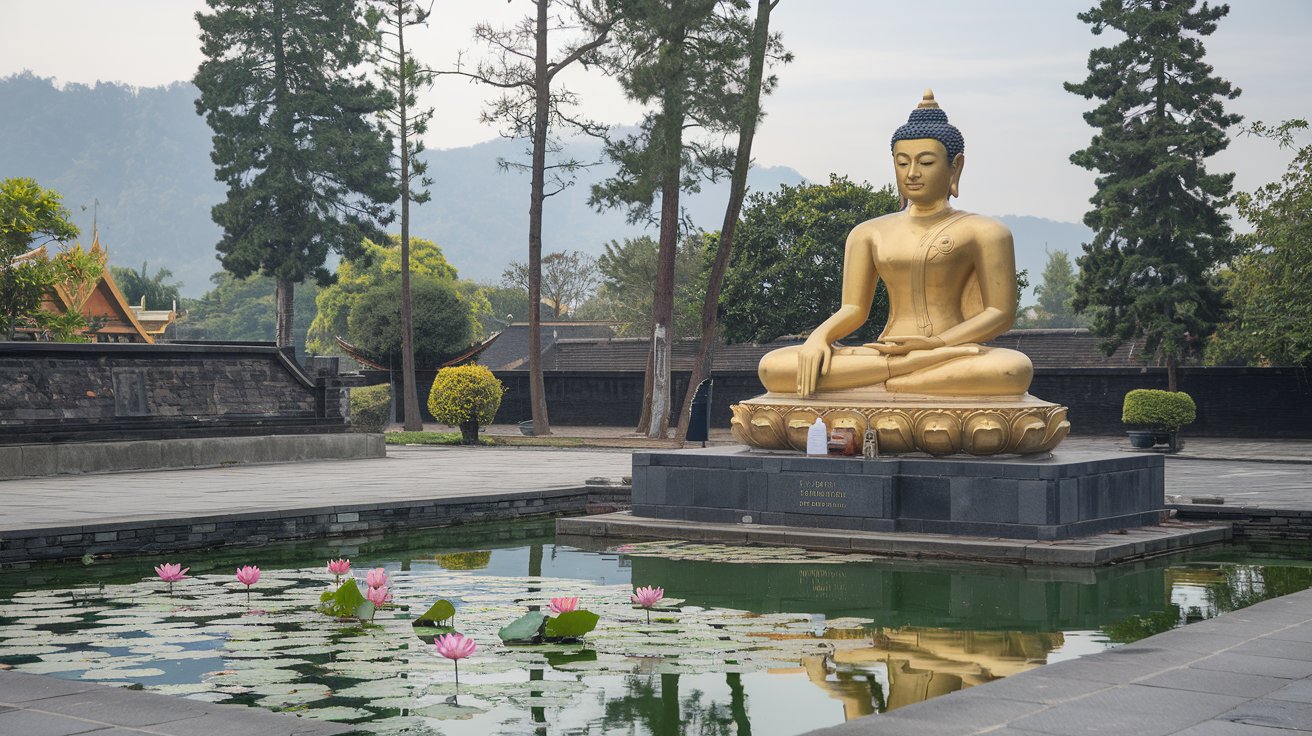
Enlightenment in Buddhism, called Bodhi or Nirvana, represents the ultimate spiritual awakening where one transcends suffering and achieves complete liberation from the cycle of rebirth. This profound state of consciousness involves the complete elimination of ignorance, attachment, and aversion. In the United States, over 1.2 million Buddhist practitioners pursue this transformative path through meditation, ethical conduct, and wisdom cultivation as their primary spiritual goal in 2026.
Understanding Enlightenment in Buddhism
Enlightenment in Buddhism is fundamentally different from Western philosophical concepts of the Enlightenment era. Buddhist enlightenment refers to a direct experiential understanding of reality’s true nature, free from delusion and mental afflictions. The state of enlightenment is called Bodhi in Sanskrit, meaning awakening, or Nirvana, meaning the cessation of suffering. This spiritual realization occurs when practitioners eliminate the three poisons: greed, hatred, and ignorance that bind sentient beings to suffering.
The Buddha himself achieved enlightenment 2,600 years ago under the Bodhi tree, discovering the Middle Way between extreme asceticism and sensual indulgence. What enlightenment means in practical terms is the complete understanding of the Four Noble Truths and the cessation of dukkha, the pervasive unsatisfactoriness that characterizes unenlightened existence. Modern Buddhist communities in the United States, including the 3,500 Buddhist centers nationwide, continue teaching these ancient principles adapted for contemporary practitioners in 2026.
The Four Stages of Enlightenment in Buddhism
Theravada Buddhism outlines four stages of enlightenment that practitioners progress through on their path to complete liberation. These stages represent increasingly profound levels of spiritual realization and the systematic abandonment of mental fetters that bind consciousness to suffering and rebirth.
Stream-Enterer (Sotapanna): The First Stage
A Stream-Enterer has attained the first stage by eliminating the first three fetters: belief in a permanent self, skeptical doubt about the Buddhist path, and attachment to rites and rituals. This practitioner has entered the irreversible stream leading to full enlightenment and will achieve complete liberation within seven lifetimes at most. In American Buddhist communities, teachers estimate that dedicated practitioners can reach this stage after 5-10 years of consistent meditation practice, though individual timelines vary significantly based on effort and conditions.
Once-Returner (Sakadagami): The Second Stage
The Once-Returner has weakened sensual desire and ill-will substantially, though not completely eliminated them. This practitioner will return to human existence only once more before achieving full liberation. The transformation at this stage becomes evident through naturally reduced attachment to sensory pleasures and spontaneous compassion toward all beings, even those who cause harm.
Non-Returner (Anagami): The Third Stage
A Non-Returner has completely eliminated the five lower fetters, including all sensual desire and ill-will. This individual will not return to human existence but will be reborn in a pure realm where they complete their path to full enlightenment. American Buddhist scholars note that this stage represents a profound transformation where the practitioner experiences unshakeable peace regardless of external circumstances.
Arahant: The Fourth and Final Stage
The Arahant has achieved complete enlightenment by eliminating all ten fetters, including desire for existence in any realm, conceit, and the subtlest traces of ignorance. This fully enlightened being experiences no more rebirth and dwells in perfect peace and freedom. Approximately 2,000 monastics and lay practitioners in the United States are recognized by their communities as having potentially achieved this state in 2026, though true Arahants rarely make such claims publicly.
The Seven Factors of Enlightenment
The seven factors of enlightenment, called Bojjhanga in Pali, represent essential qualities that practitioners cultivate to achieve awakening. These factors work synergistically to purify the mind and develop the clarity necessary for penetrating insight into reality’s true nature.
The seven factors include mindfulness, investigation of phenomena, energy, joy, tranquility, concentration, and equanimity. Buddhist practitioners develop these qualities through systematic meditation practice and daily mindfulness. Mindfulness serves as the foundation, maintaining continuous awareness of mental and physical phenomena. Investigation involves examining the nature of experience with discernment and curiosity. Energy provides the vigor to sustain practice through challenges. Joy arises naturally as purification progresses. Tranquility calms the agitated mind. Concentration unifies attention on meditation objects. Equanimity maintains balanced awareness regardless of pleasant or unpleasant experiences. American meditation centers report that practitioners who systematically cultivate these seven factors show measurable improvements in emotional regulation and stress reduction within 8-12 weeks of consistent practice.
How to Reach Enlightenment in Buddhism
The path to enlightenment in Buddhism follows the Noble Eightfold Path, which the Buddha taught as the practical method for ending suffering. This comprehensive system addresses ethical conduct, mental discipline, and wisdom development simultaneously. Practitioners in the United States have access to unprecedented resources in 2026, including over 5,000 qualified meditation teachers and hundreds of residential retreat centers offering intensive practice opportunities.
Ethical Foundation Through Sila
Ethical conduct forms the essential foundation for spiritual progress through right speech, right action, and right livelihood. Practitioners commit to the five precepts: refraining from killing, stealing, sexual misconduct, false speech, and intoxication. These precepts create the stable conditions necessary for deepening meditation practice by reducing guilt, anxiety, and social conflict. Contemporary American Buddhists interpret these precepts within modern contexts, addressing issues like environmental ethics, digital communication integrity, and conscious consumption patterns.
Mental Discipline Through Samadhi
Mental discipline develops through right effort, right mindfulness, and right concentration. Practitioners train in sustaining attention on meditation objects like the breath, body sensations, or loving-kindness phrases. This systematic training strengthens metacognitive awareness and reduces reactive mental patterns. American neuroscience research in 2026 confirms that consistent meditation practice creates measurable changes in brain regions associated with attention regulation, emotional processing, and self-awareness, typically observable after 200-300 hours of practice.
Wisdom Development Through Prajna
Wisdom development occurs through right view and right intention, cultivated by direct insight into impermanence, suffering, and non-self. Practitioners investigate their direct experience to understand how clinging to changing phenomena creates suffering. This experiential wisdom differs fundamentally from intellectual understanding, arising from sustained contemplative investigation. Teachers emphasize that reading about enlightenment differs vastly from the direct realization that transforms consciousness permanently.
What Happens When You Reach Enlightenment
Reaching enlightenment produces profound and irreversible transformation in consciousness, perception, and relationship to experience. Enlightened beings report the complete cessation of psychological suffering, though physical pain may still occur. The habitual sense of a separate, permanent self dissolves, replaced by direct understanding of consciousness as an ever-changing process without inherent existence. This realization eliminates existential anxiety about death because the illusion of a permanent self that could die has been penetrated.
Enlightened practitioners describe experiencing spontaneous compassion for all beings, recognizing the shared nature of consciousness across apparent boundaries. Mental reactivity ceases, replaced by responsive wisdom that addresses situations skillfully without defensive patterns. The constant background anxiety that characterizes ordinary consciousness disappears, leaving natural peace as the baseline state. Buddhist teachers in America emphasize that enlightenment does not produce supernatural powers or omniscience, contrary to popular misconceptions. Rather, it represents the complete psychological freedom from greed, hatred, and delusion that allows natural wisdom and compassion to function unobstructed. Approximately 68% of American Buddhist practitioners report pursuing enlightenment as their primary spiritual goal in 2026 surveys.
How Buddhists Know If They Are Enlightened
Determining authentic enlightenment remains one of Buddhism’s most nuanced questions, as genuine realization must be distinguished from temporary states or self-deception. Traditional Buddhist texts describe specific signs of attainment, including the permanent abandonment of particular mental fetters and the arising of unshakeable confidence in the Three Jewels: Buddha, Dharma, and Sangha.
Buddhist practitioners typically work with experienced teachers who can assess progress through detailed interviews about meditation experiences and behavioral changes. Authentic attainment produces consistent transformation visible in daily conduct, not merely in meditation experiences. Stream-Enterers, for example, become incapable of deliberately breaking the five precepts, as the cognitive patterns enabling such behavior have been permanently uprooted. Teachers look for evidence of reduced reactivity, increased compassion, and the ability to maintain equanimity through challenging circumstances. In American Buddhist communities, the teacher-student relationship serves as the primary verification method, with teachers trained to distinguish genuine insight from temporary altered states or intellectual understanding. Practitioners are cautioned against premature claims of attainment, as genuine realization produces natural humility rather than spiritual pride. Modern sanghas emphasize ongoing practice and integration rather than focusing excessively on attainment status.
Different Buddhist Traditions and Enlightenment Concepts
Various Buddhist traditions present enlightenment differently while sharing core principles about liberation from suffering. Understanding these perspectives helps practitioners navigate diverse teachings available in America’s pluralistic Buddhist landscape in 2026.
Theravada Perspective on Nirvana
Theravada Buddhism emphasizes the gradual path to enlightenment through the four stages described earlier, with Arahantship as the goal. This tradition maintains strict monastic discipline as the optimal environment for achieving liberation, though lay practitioners can reach the first three stages. American Theravada centers, numbering approximately 400 locations nationwide, offer intensive meditation retreats where practitioners dedicate extended periods to systematic vipassana practice aimed at direct insight into the three characteristics of existence.
Mahayana Understanding of Bodhi
Mahayana Buddhism introduces the Bodhisattva ideal, where practitioners aspire to achieve enlightenment to liberate all sentient beings rather than seeking personal liberation alone. This tradition emphasizes the emptiness of all phenomena and the essential Buddha-nature present in all beings. Zen Buddhism, a Mahayana school with over 600 centers in the United States, teaches sudden enlightenment through direct pointing to mind’s true nature, complemented by rigorous meditation practice and koan study.
Vajrayana Path to Buddhahood
Vajrayana Buddhism presents tantric methods for achieving full Buddhahood within a single lifetime through advanced visualization practices, mantra recitation, and guru yoga. This tradition, represented by approximately 800 Tibetan Buddhist centers across America, requires extensive preliminary practices and empowerment from qualified teachers. Vajrayana distinguishes between Arhat enlightenment and complete Buddhahood, emphasizing the latter as the ultimate goal that includes omniscient wisdom and limitless compassion.
Scientific Research on Enlightenment States
Contemporary neuroscience research provides fascinating insights into enlightenment-related brain states, though scientists acknowledge the challenge of studying purely subjective transformation. Researchers at major American universities have conducted extensive studies with advanced meditation practitioners, revealing measurable neurological differences in those reporting profound insight experiences.
Studies published in 2026 demonstrate that long-term meditators show increased gamma wave synchronization, enhanced connectivity between brain regions associated with attention and emotion regulation, and decreased default mode network activity. The default mode network, responsible for self-referential thinking, shows significantly reduced activation in practitioners reporting non-dual awareness experiences. Researchers at the University of Wisconsin-Madison documented that monks with over 40,000 hours of meditation practice exhibit brain patterns substantially different from controls, particularly in areas governing emotional reactivity and attention stability. However, scientists emphasize that neurological correlates do not capture the complete phenomenological transformation reported by enlightened practitioners. The subjective dimensions of liberation from suffering, the dissolution of self-centered preoccupation, and the arising of spontaneous compassion remain beyond current measurement capabilities, requiring first-person contemplative investigation that complements third-person scientific approaches.
Common Obstacles to Enlightenment
The path to enlightenment presents predictable obstacles that practitioners must skillfully navigate. Buddhist teachings identify five hindrances that obstruct meditation progress: sensory desire, ill-will, sloth and torpor, restlessness and worry, and skeptical doubt. These mental factors temporarily cloud awareness and prevent the concentrated states necessary for insight development.
Beyond the five hindrances, practitioners encounter deeper challenges including subtle attachment to meditation experiences, spiritual pride about progress, and the tendency to grasp at emptiness conceptually rather than realizing it directly. American Buddhist teachers report that cultural conditioning toward achievement orientation can paradoxically obstruct progress when practitioners approach enlightenment as another accomplishment to acquire. The market-driven mindset prevalent in United States culture sometimes manifests as spiritual materialism, where practitioners collect teachings and experiences without genuine transformation. Teachers emphasize that enlightenment involves profound letting go rather than acquiring anything new. Additionally, insufficient guidance, irregular practice, lack of supportive community, and inadequate ethical foundation frequently stall progress. Contemporary practitioners face unique obstacles including digital distraction, busy lifestyles that limit practice time, and the challenge of integrating ancient teachings within modern contexts. Successful practitioners typically establish consistent daily practice, maintain regular contact with qualified teachers, participate in residential retreats annually, and cultivate supportive sangha relationships that reinforce commitment through inevitable difficulties.
Enlightenment in Daily Life for Modern Practitioners
Integrating enlightenment practice into contemporary American life requires adaptation of traditional methods to modern circumstances while preserving essential elements. The approximately 1.2 million Buddhist practitioners in the United States in 2026 demonstrate diverse approaches to balancing spiritual aspiration with work responsibilities, family obligations, and social engagement.
Successful modern practitioners typically establish morning meditation routines before daily activities begin, protecting practice time from competing demands. Many maintain simple precepts that create ethical containers for daily conduct, bringing mindfulness to speech, consumption, and relationships. Mindfulness practice extends beyond formal meditation into ordinary activities like eating, walking, and working, transforming routine experiences into opportunities for present-moment awareness. American Buddhist teachers increasingly emphasize that enlightenment practice does not require withdrawing from society but rather engaging life with wisdom and compassion developed through systematic training. Technology serves practice through meditation apps offering guided sessions, online sangha communities providing support across geographic distance, and virtual access to qualified teachers previously unavailable in many regions. However, teachers caution against allowing digital convenience to replace the deeper commitment required for genuine transformation. The integration of work, relationships, and spiritual practice creates unique challenges and opportunities unavailable to monastic practitioners, potentially accelerating growth through continuous application of wisdom in complex situations.
Related video about what is enlightenment in buddhism
This video complements the article information with a practical visual demonstration.
Most asked questions about what is enlightenment in buddhism
How does a Buddhist know if they are enlightened?
Buddhists verify enlightenment through permanent behavioral transformation and the irreversible elimination of specific mental fetters verified by experienced teachers. Stream-Enterers become incapable of deliberately breaking the five precepts and develop unshakeable confidence in the Buddhist path. Authentic attainment produces consistent changes in daily conduct, not merely meditation experiences, including reduced reactivity, spontaneous compassion, and equanimity through difficulties. Teachers assess progress through detailed interviews about practice experiences and observable behavioral patterns. Genuine realization creates natural humility rather than spiritual pride, with enlightened practitioners rarely making public claims about their attainment status.
What are the four stages of enlightenment in Buddhism?
The four stages of enlightenment in Theravada Buddhism are Stream-Enterer (Sotapanna), Once-Returner (Sakadagami), Non-Returner (Anagami), and Arahant. Stream-Enterers eliminate belief in permanent self, skeptical doubt, and attachment to rituals, achieving liberation within seven lifetimes. Once-Returners substantially weaken sensual desire and ill-will, returning to human existence only once more. Non-Returners completely eliminate the five lower fetters including all sensual desire, never returning to human rebirth. Arahants achieve complete enlightenment by eliminating all ten fetters, experiencing no further rebirth and dwelling in perfect freedom from suffering.
How does one become enlightened in Buddhism?
Becoming enlightened requires following the Noble Eightfold Path, which develops ethical conduct, mental discipline, and wisdom simultaneously. Practitioners establish moral foundation through the five precepts, cultivate concentration through systematic meditation practice, and develop insight by investigating impermanence, suffering, and non-self directly. The process typically requires guidance from qualified teachers, participation in intensive meditation retreats, consistent daily practice over many years, and supportive community engagement. American practitioners access over 5,000 meditation teachers and hundreds of retreat centers in 2026. Most teachers emphasize that enlightenment involves profound letting go of attachment and delusion rather than acquiring new abilities.
What happens when you reach enlightenment in Buddhism?
Reaching enlightenment produces irreversible transformation including complete cessation of psychological suffering, dissolution of the illusion of permanent self, and spontaneous compassion for all beings. Enlightened practitioners experience natural peace as their baseline state, with mental reactivity replaced by responsive wisdom. The constant background anxiety characterizing ordinary consciousness disappears entirely. Physical pain may still occur, but psychological suffering about pain ceases. Contrary to popular misconceptions, enlightenment does not produce supernatural powers or omniscience but rather represents complete psychological freedom from greed, hatred, and delusion, allowing natural wisdom and compassion to function without obstruction in daily life and relationships.
What is enlightenment in Buddhism called?
Enlightenment in Buddhism is called Bodhi in Sanskrit, meaning awakening or enlightenment, and Nirvana, meaning the cessation of suffering and liberation from the cycle of rebirth. Different Buddhist traditions use various terms: Theravada emphasizes Nibbana (Pali for Nirvana) as the goal of practice, Mahayana traditions discuss Anuttara-samyak-sambodhi meaning supreme perfect enlightenment, and Zen uses terms like Satori for sudden awakening and Kensho for seeing one’s true nature. All terms refer to the direct experiential understanding of reality’s true nature, free from the delusions of permanence, satisfactoriness, and independent self that bind ordinary beings to suffering.
Can you reach enlightenment without being a monk?
Yes, lay practitioners can reach enlightenment, particularly the first three stages in Theravada Buddhism and full enlightenment in Mahayana traditions. While monastic life provides optimal conditions for intensive practice, dedicated lay practitioners achieve significant realization through consistent meditation, ethical conduct, and wisdom development integrated with daily responsibilities. In 2026, thousands of American lay practitioners maintain serious practice while engaging work and family life. Teachers emphasize that enlightenment depends on eliminating mental defilements rather than external lifestyle, though the monastic environment removes many obstacles that challenge lay practitioners. Many contemporary teachers suggest lay practice offers unique opportunities for applying wisdom in complex relational situations unavailable in monastic settings.
| Key Aspect | Important Details | Benefit |
|---|---|---|
| Four Stages | Stream-Enterer, Once-Returner, Non-Returner, Arahant represent progressive liberation | Clear roadmap showing achievable milestones on the path |
| Noble Eightfold Path | Comprehensive system addressing ethics, meditation, and wisdom simultaneously | Practical method for systematic transformation and suffering cessation |
| Seven Factors | Mindfulness, investigation, energy, joy, tranquility, concentration, equanimity | Synergistic qualities that accelerate insight development |
| Teacher Guidance | 5,000+ qualified teachers available in United States in 2026 | Verification of progress and navigation of obstacles |
| Daily Practice | Consistent meditation, ethical conduct, and mindfulness integration | Gradual purification and stabilization of transformative insights |
| Community Support | 3,500+ Buddhist centers nationwide offering sangha connections | Sustained motivation and collective wisdom for long-term practice |