
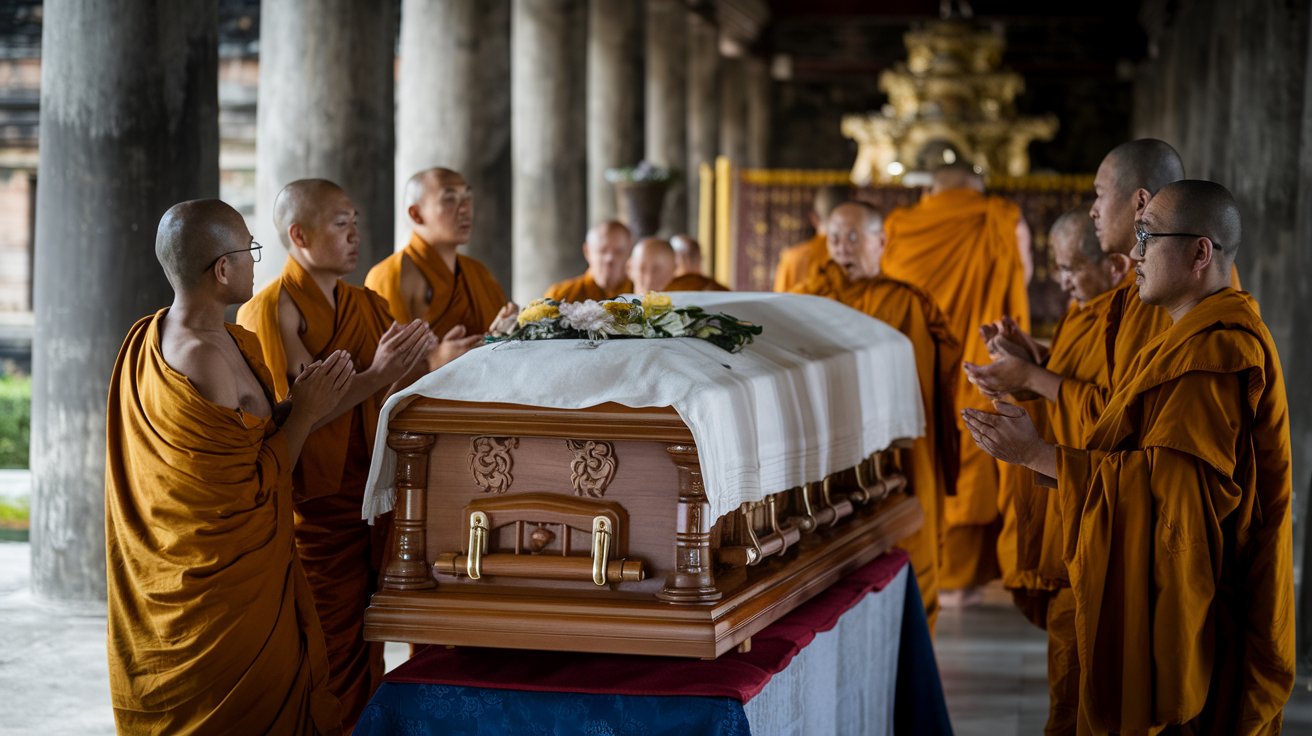
The 7-day Buddhist death ritual represents a critical transition period in Buddhist funeral traditions, where the deceased’s consciousness begins its journey toward rebirth. During these first seven days, families perform specific ceremonies and rituals to guide the departed soul and accumulate merit. Understanding these Buddhist death rituals helps families honor their loved ones properly while supporting the spiritual transition that Buddhists believe occurs immediately after death.
Understanding the 7-Day Buddhist Death Ritual
The 7-day death ritual in Buddhism marks the first of seven transitional periods called bardo states, each lasting seven days up to 49 days total. Buddhist teachings suggest that consciousness remains in an intermediate state during this time, making the first week particularly significant. Families gather to perform memorial services and chant sutras to generate positive karma that assists the deceased’s journey. In the United States, approximately 1.2% of the population identifies as Buddhist as of 2026, with growing awareness of these sacred traditions.
The seventh day ceremony concludes the first bardo period and typically involves the most elaborate rituals of the initial week. Monks are invited to chant protective scriptures, family members offer food to the monastic community, and prayers are directed toward the deceased’s peaceful transition. This Buddhist ritual varies across different traditions including Theravada, Mahayana, and Vajrayana schools, but the fundamental principle of supporting the deceased through merit-making remains constant throughout all Buddhist cultures.
What Happens Immediately When Someone Dies in Buddhism
When a Buddhist dies, practitioners believe the consciousness begins separating from the physical body, a process that may take several hours to complete. Family members traditionally avoid touching or moving the body for 3-8 hours after clinical death to prevent disturbing this delicate transition. The dying person’s environment is kept peaceful and quiet, with Buddhist monks or practitioners reciting scriptures to guide the consciousness toward positive rebirth. In hospital settings across the United States, Buddhist families increasingly request private rooms where these death rituals can be performed without interruption.
The immediate period following death involves specific preparations aligned with Buddhist funeral traditions. The body is typically washed and dressed in simple, clean clothing, often white or the deceased’s monastic robes if they were ordained. Incense is lit continuously, and a picture of the deceased is placed with offerings of fruits, flowers, and water. During these first hours, family members begin chanting mantras or the deceased’s favorite sutras, creating a ritual atmosphere that supports spiritual transition rather than expressing grief loudly, which Buddhists believe could disturb the departing consciousness.
Day-by-Day Buddhist Rituals During the First Week
The first three days after death focus intensely on guiding the consciousness through its initial confusion in the bardo state. Family members maintain continuous prayer rotations, ensuring someone is always chanting sutras near the body or memorial altar. Buddhist texts suggest the consciousness remains close to its former body during this time, making these 3-day rituals particularly important. Monks typically visit daily to perform ceremonial chanting, with the Tibetan Book of the Dead often read aloud to provide navigation instructions for the deceased’s awareness navigating the intermediate realm.
From day four through day seven, the ritual intensity continues with preparation for the seventh-day ceremony. Families continue daily offerings of food, water, and incense while maintaining regular sutra recitations. The deceased’s favorite foods are symbolically offered, though consumed by living family members or donated to monks to generate merit. By the seventh day, elaborate ceremonies are conducted where monks perform extensive chanting sessions, often lasting several hours, and family members make substantial donations to temples or charitable causes in the deceased’s name, accumulating merit believed to directly benefit the transitioning consciousness.
Buddhist Funeral Services and Ceremonies
Buddhist funeral services in the United States blend traditional Asian practices with American funeral customs, creating unique hybrid ceremonies that honor both cultures. The funeral typically occurs within the first seven days, often on the third, fifth, or seventh day after death. Modern Buddhist temples in major US cities like Los Angeles, New York, and San Francisco conduct approximately 15-25 funeral services monthly as of 2026, reflecting the growing Buddhist community. These services include formal sutra chanting, eulogies focusing on the deceased’s virtuous qualities, and meditation periods where attendees generate compassionate thoughts toward the departed.
Funeral Service Structure and Format
A typical Buddhist funeral service begins with guests arriving and offering incense at the altar displaying the deceased’s photograph. Attendees dress in subdued colors, with black, white, or dark blue being most appropriate, avoiding bright reds which symbolize celebration. The ceremony proceeds with opening chants led by monks or lay practitioners, followed by a reading of the deceased’s life story emphasizing their positive karma and spiritual practice. Unlike Western funerals, emotional restraint is valued, as Buddhism teaches that excessive grief can burden the deceased’s transitional journey with attachment and worry.
Role of Monks and Spiritual Leaders
Buddhist monks serve as spiritual guides throughout the funeral process, offering prayers that accumulate merit for the deceased while teaching attendees about impermanence and rebirth. In Theravada traditions, monks chant Pali scriptures while family members pour water into a vessel, symbolically transferring merit. Mahayana services often include the Heart Sutra and Amitabha Buddha invocations, helping the deceased reach the Pure Land. Vajrayana practitioners may perform elaborate rituals including mandala offerings and deity visualizations. Across all traditions, the monastic community receives food offerings and donations, with this generosity directly benefiting the deceased through the Buddhist principle of merit transference.
The Significance of the 49-Day Mourning Period
While the 7-day ritual marks the first milestone, Buddhist tradition recognizes a complete 49-day journey through seven successive bardo periods of seven days each. Every seventh day (7th, 14th, 21st, 28th, 35th, 42nd, and 49th) marks a critical transition point when the consciousness faces potential rebirth. Families conduct memorial ceremonies on each of these days, with the 49th day representing the final determination of the rebirth realm. This extended mourning structure differentiates Buddhist death rituals from many Western traditions that conclude services within days of death.
During the 49 days, families maintain home altars with daily offerings and regular sutra recitations. Contemporary American Buddhist families often balance traditional observances with work obligations, conducting abbreviated morning and evening prayers while reserving intensive rituals for the seven-day milestones. Temple communities support families through group prayer sessions and educational programs explaining the Buddhist cosmology of death and rebirth. By the 49th day ceremony, an elaborate final service releases the family from intensive mourning obligations, though annual memorial services continue on death anniversaries to honor the deceased’s memory and continue generating positive karma.
Buddhist Death Rituals Across Different Traditions
Theravada Buddhist traditions, prevalent among Southeast Asian communities in the United States, emphasize simplicity and monk-led chanting of Pali scriptures. Thai, Cambodian, and Burmese temples conduct three-day to seven-day funeral periods with daily almsgiving to monks, merit-making ceremonies, and eventual cremation. The body typically remains at the temple or funeral home where families visit daily, bringing food offerings and participating in evening chanting sessions. Theravada rituals focus on the impermanent nature of existence and the accumulation of merit through generosity, moral conduct, and meditation practice dedicated to the deceased.
Mahayana and Vajrayana traditions include more elaborate ceremonial elements reflecting Chinese, Japanese, Korean, and Tibetan cultural influences. Japanese Pure Land services invoke Amitabha Buddha to guide the deceased to the Western Paradise, while Zen funerals emphasize the teaching of emptiness and non-attachment. Tibetan Buddhist death rituals may include phowa consciousness transference practices, elaborate visualization ceremonies, and continuous reading of the Bardo Thodol. Chinese Buddhist families often incorporate ancestral veneration alongside Buddhist practices, burning incense and joss paper while monks perform instrumental music and chanting. These diverse traditions reflect Buddhism’s adaptation across cultures while maintaining core principles of supporting the deceased’s spiritual transition.
What to Expect at a Buddhist Funeral in the United States
Attending a Buddhist funeral in America presents a blend of traditional Asian customs and Western funeral conventions. Guests typically gather at a temple, funeral home, or family residence where an altar displays the deceased’s photograph surrounded by flowers, candles, and incense. Upon arrival, attendees approach the altar to offer incense, performing a slight bow or placing hands together in prayer position. Dress codes emphasize respectful, conservative clothing in dark or neutral colors, with white being acceptable unlike Western customs where it’s associated with weddings rather than mourning.
Proper Etiquette and Behavior
Buddhist funeral etiquette emphasizes quiet respect and emotional composure rather than overt displays of grief. Guests sit silently during sutra chanting, which may last 30-90 minutes depending on the tradition and service length. It’s appropriate to follow along if you know the chants, or simply sit respectfully with a calm demeanor. Photography is generally discouraged unless explicitly permitted by the family. When offering condolences, brief, sincere expressions acknowledging the deceased’s positive qualities are appreciated, avoiding phrases suggesting permanent loss since Buddhists believe in rebirth and continued existence in different forms.
Gift-Giving and Monetary Offerings
Monetary gifts called funeral donations are customary at Buddhist services, typically presented in white envelopes to help offset ceremony costs and make offerings to monks. In 2026, appropriate amounts in US Buddhist communities range from $50-$300 depending on relationship closeness and regional customs. These funds support temple operations and monastic communities, generating merit that’s dedicated to the deceased. Some families request donations to specific charities instead, honoring the Buddhist value of compassionate action. Food offerings brought to the family home should be vegetarian or vegan, as many Buddhist families observe meat abstinence during mourning periods.
Cremation and Body Disposition in Buddhist Practice
Cremation remains the predominant disposition method in Buddhist traditions, symbolizing the impermanent nature of physical existence and the soul’s liberation from bodily attachment. Approximately 78% of Buddhist funerals in the United States involve cremation as of 2026, significantly higher than the national average of 61%. The cremation typically occurs after the initial funeral service, often on the seventh day following death, though modern scheduling constraints sometimes necessitate earlier cremation with memorial services held later. Buddhist cremations may include brief ceremonies at the crematorium where monks offer final prayers and family members participate in symbolic acts like placing flowers or lighting the cremation fire.
Following cremation, Buddhist families handle ashes according to various traditional and personal preferences. Some traditions involve scattering ashes in meaningful locations like oceans, rivers, or mountains, returning the elements to nature. Others place cremated remains in temple columbaria where regular memorial services continue. Japanese Buddhist traditions sometimes divide ashes among family members and temple repositories. The handling of remains emphasizes respect for the physical vessel that housed consciousness while recognizing its ultimate impermanence. Modern American Buddhists increasingly choose eco-friendly options like biodegradable urns or memorial reef placements that align with Buddhist values of environmental harmony and non-harm.
Buddhism’s View on Death and Rebirth
Buddhist philosophy views death not as an ending but as a transitional moment within the continuous cycle of samsara—birth, death, and rebirth driven by karma. The consciousness that animates each lifetime carries accumulated karmic imprints that determine the circumstances of the next rebirth. This understanding fundamentally shapes Buddhist death rituals, which focus on supporting positive karmic conditions for favorable rebirth rather than mourning permanent loss. The quality of one’s final thoughts and the accumulated merit from lifetime actions significantly influence the rebirth destination across six possible realms including heavenly, human, animal, and hell realms.
The bardo state between death and rebirth represents a period of heightened opportunity and vulnerability where the consciousness experiences visions and encounters related to its karmic accumulations. Buddhist texts describe this intermediate state as lasting up to 49 days, during which the deceased’s awareness gradually loses connection with its previous life while moving toward the next incarnation. Family rituals during this period—prayers, offerings, merit-making activities—are believed to genuinely assist the deceased’s journey by creating positive karmic conditions. This theological framework explains why Buddhist mourning practices extend across weeks rather than concluding quickly, reflecting the understanding that spiritual support remains actively beneficial throughout the transitional process.
Buddhist Communities and Resources in the United States
The United States Buddhist population reached approximately 4.2 million practitioners in 2026, concentrated in California, Hawaii, New York, and the Pacific Northwest. Los Angeles County hosts the largest Buddhist concentration with over 300 temples representing diverse traditions including Zen, Pure Land, Tibetan, Theravada, and various ethnic communities. New York City follows with approximately 200 temples serving Chinese, Korean, Japanese, Vietnamese, and Tibetan populations. San Francisco, Seattle, and Houston complete the top five cities for Buddhist community resources, each offering multiple temples, meditation centers, and funeral service providers familiar with traditional death rituals.
American Buddhist organizations provide extensive support for families navigating death and mourning processes. The Buddhist Churches of America, Insight Meditation Society, Shambhala International, and numerous ethnic temple associations offer educational resources, ceremonial guidance, and community support networks. Many temples maintain dedicated funeral committees staffed by experienced practitioners who guide families through ritual requirements, coordinate with funeral homes, and organize memorial services. Online platforms increasingly supplement traditional temple services, with virtual prayer sessions, educational webinars about Buddhist death practices, and digital memorial spaces becoming standard offerings since 2024, particularly valuable for geographically dispersed families maintaining traditional observances.
Continuing Memorial Practices Beyond 49 Days
After the 49-day period concludes, Buddhist families continue honoring the deceased through annual memorial services called death anniversaries. The first-year anniversary typically involves elaborate ceremonies comparable to the initial funeral, with monks invited for extended chanting sessions and substantial offerings made in the deceased’s name. Subsequent anniversaries on the third, seventh, thirteenth, seventeenth, and sometimes thirty-third years mark significant memorial milestones in various Buddhist traditions. These continuing remembrances maintain the deceased’s memory within family consciousness while generating ongoing merit that benefits both the departed and living family members through the practice of generosity and spiritual reflection.
Many Buddhist families maintain home altars permanently dedicated to deceased relatives, offering daily incense, water, and periodic food offerings alongside ancestor tablets inscribed with names and death dates. These practices particularly characterize Chinese and Vietnamese Buddhist households where ancestral veneration integrates with Buddhist merit-making philosophy. Modern American adaptations include digital memorial websites, annual temple donation drives honoring deceased loved ones, and participation in community memorial services like Obon festivals celebrating ancestral spirits. The emphasis remains consistent across adaptations: maintaining loving connection with the deceased while accumulating positive karma through virtuous actions performed in their memory, demonstrating Buddhism’s integrated approach to honoring both spiritual practice and familial bonds.
Adapting Buddhist Death Rituals in Modern American Life
Contemporary American Buddhists face unique challenges balancing traditional 7-day and 49-day observances with modern work schedules, geographic dispersion, and multicultural family dynamics. Many families adopt abbreviated daily practices during the 49-day period, conducting intensive rituals only on the seven-day milestones while maintaining brief morning and evening prayers at home altars. Some temples offer weekend memorial packages that concentrate ceremonies into days when working family members can attend, while maintaining the ritual count through continuous temple-based chanting that families sponsor but don’t necessarily attend in person.
Interfaith families navigating Buddhist death rituals increasingly create hybrid services honoring multiple traditions respectfully. A service might include Buddhist sutra chanting followed by Christian prayers, or incorporate Native American smudging alongside traditional incense offerings. Funeral homes in areas with significant Buddhist populations now train staff in appropriate ritual accommodations, providing incense-friendly viewing rooms, vegetarian reception options, and extended visitation hours supporting multi-day observances. This cultural adaptation demonstrates Buddhism’s characteristic flexibility, maintaining essential spiritual principles while adjusting external forms to contemporary American contexts, ensuring these ancient death rituals remain accessible and meaningful for new generations of practitioners in the United States.
Related video about buddhist death rituals 7 days
This video complements the article information with a practical visual demonstration.
Everything you need to know about buddhist death rituals 7 days
What is the 7 day death ritual in Buddhism?
The 7-day Buddhist death ritual marks the completion of the first bardo period in the 49-day transition between death and rebirth. On the seventh day after death, families conduct an elaborate memorial ceremony with monks chanting sutras, offerings made to the monastic community, and merit dedicated to the deceased. This ritual supports the consciousness during its first critical transition point in the intermediate state. The ceremony typically includes extended prayer sessions, food offerings, and charitable donations made in the deceased’s name to accumulate positive karma that benefits their spiritual journey.
What rituals do Buddhists perform when someone dies?
Buddhist death rituals begin immediately after death with peaceful chanting and avoiding body disturbance for several hours to allow consciousness separation. The body is washed, dressed in simple clothing, and surrounded by incense and offerings. Monks are invited to recite protective scriptures while family members maintain continuous prayer rotations. Services occur within the first seven days, followed by memorial ceremonies every seventh day for 49 days total. Families make offerings, donate to temples, and dedicate merit-generating activities to support the deceased’s transition through the bardo state toward positive rebirth. Cremation typically follows the initial funeral service.
What US city has the most Buddhists?
Los Angeles has the largest Buddhist population in the United States as of 2026, with over 300 temples representing diverse traditions including Japanese, Chinese, Korean, Thai, Vietnamese, and Tibetan communities. The greater Los Angeles area hosts approximately 350,000-400,000 Buddhist practitioners. New York City ranks second with around 200 temples and 200,000-250,000 Buddhists. San Francisco, Honolulu, and Seattle complete the top five cities. California overall contains nearly 40% of all American Buddhists, reflecting historical Asian immigration patterns and the state’s cultural diversity that has supported flourishing Buddhist communities across multiple traditions.
What color should you wear to a Buddhist funeral?
Appropriate Buddhist funeral attire includes black, white, dark blue, gray, or other subdued neutral colors. Unlike Western customs where white symbolizes weddings, white is actually traditional mourning color in many Asian Buddhist cultures and is perfectly acceptable. Black remains universally appropriate across all Buddhist traditions in American contexts. Avoid bright colors, especially red, which symbolizes celebration and joy in Buddhist cultures. Conservative, modest clothing showing respect is essential. Some traditions prefer earth tones or simple, unadorned garments. When uncertain, dark business attire provides safe, respectful choices for attending any Buddhist funeral service in the United States.
How long do Buddhist mourning rituals last?
The intensive Buddhist mourning period lasts 49 days following death, divided into seven periods of seven days each. Memorial ceremonies occur every seventh day (days 7, 14, 21, 28, 35, 42, and 49), with the seventh and 49th day services being most elaborate. During this time, families maintain daily offerings and prayers at home altars. After 49 days, annual memorial services continue on death anniversaries, with the first, third, seventh, and sometimes thirteenth and thirty-third year anniversaries being particularly significant. While intensive daily rituals conclude after 49 days, remembrance practices and merit-making activities honoring the deceased continue throughout the family’s lifetime.
Can non-Buddhists attend Buddhist funeral services?
Non-Buddhists are welcome at Buddhist funeral services and their attendance honors the deceased and supports grieving family members. Guests should dress conservatively in dark or neutral colors, arrive on time, and maintain quiet, respectful demeanor during chanting. It’s appropriate to offer incense at the altar upon arrival by lighting a stick, bowing slightly, and placing it in the incense holder. You need not know the chants—sitting respectfully with calm presence suffices. Monetary donations in white envelopes are customary but not mandatory. Follow the family’s lead regarding bowing, and offer brief, sincere condolences. Understanding that Buddhist services emphasize supporting the deceased’s spiritual transition rather than emotional expression helps non-Buddhist attendees participate appropriately.
| Ritual Period | Key Practices | Spiritual Purpose |
|---|---|---|
| Immediate (0-3 days) | Body undisturbed, continuous chanting, peaceful environment, monks recite scriptures | Support consciousness separation from body, guide initial bardo transition |
| First Week (Days 1-7) | Daily offerings, funeral service, seventh-day ceremony, merit-making activities | Complete first bardo period, establish positive karmic conditions for rebirth |
| 49-Day Period | Weekly ceremonies every 7 days, home altar maintenance, temple donations | Guide consciousness through seven bardo transitions until rebirth determination |
| Annual Memorials | Death anniversary services, offerings, charitable donations in deceased’s name | Continue merit accumulation, maintain family connection, honor memory |
| Ongoing Practice | Home altar offerings, virtuous actions dedicated to deceased, community participation | Generate continuous positive karma benefiting both deceased and living family |